


Fortifying Your Nonprofit Website Architecture Before High-Traffic Giving Days

Stop Letting Bad Tech Sabotage Your Mission
Picture this. It’s the morning of Giving Tuesday. Your marketing director has spent the last three months hyping up the campaign. The email sequences are locked, your social media channels are firing on all cylinders, and the traffic starts surging. Then, the absolute worst-case scenario happens: your website crashes. You’re staring at a 504 Gateway Error, and you’re bleeding donation revenue by the second.
Listen to me: hope is not a strategy. If you want to scale your organization’s impact, you have to stop treating your tech stack as an afterthought. You need to treat your giving days website architecture like the mission-critical, revenue-generating infrastructure it actually is.
Because a giving day concentrates so much of a year’s online giving into a few hours, even a short outage at the wrong moment can cost a nonprofit donations it won’t get back. You can’t afford to run high-stakes campaigns on a brittle foundation. It is time to audit, optimize, and fortify your systems before the traffic hits.
Why Your Giving Days Website Architecture Dictates Your Impact
A lot of nonprofit leaders and marketing directors are incredibly growth-oriented, but they are also totally overwhelmed by the rapid evolution of digital marketing. You’re busy running the organization. You don’t have time to worry about server caching or database queries. But here is the truth: your website’s architecture is the silent partner in every single campaign you run.
When we talk about architecture, we aren’t just talking about where the buttons go. We are talking about how your WordPress site handles a sudden influx of concurrent users. We’re talking about how your third-party donation plugins communicate with your database, how your images are served, and whether your server can dynamically scale resources.
Most nonprofits fail here because they treat website design as a purely creative exercise. They hire a shop to make the site look pretty, but nobody looks under the hood to see if the engine can handle a thousand people trying to process a credit card at the exact same moment. You need a system built for scale.
A true architecture audit looks beyond the aesthetics to stress-test your foundation. We focus on optimizing server caching, streamlining database queries, auditing third-party donation plugins, and ensuring your server can dynamically scale resources to handle thousands of concurrent users processing credit cards at the exact same moment.
A resilient giving day architecture relies heavily on Content Delivery Networks (CDNs) like Cloudflare and dedicated load balancers to manage sudden traffic spikes. By offloading static assets—such as campaign videos, hero images, and CSS files—a CDN ensures that your primary server resources remain dedicated to processing dynamic database requests and user sessions. Coupled with a load balancer to distribute incoming traffic across multiple servers, this approach prevents any single point of failure from taking down your donation pages when concurrent visitor numbers surge.
Designing a Searchable Frontend
While backend capacity keeps your site online, your frontend architecture determines whether visitors actually convert. A successful giving day website requires intuitive navigation and a highly searchable experience, allowing donors to quickly find specific funds or programs. Structuring your site’s categories, tags, and search functions logically ensures users can support their interests without friction.
The Playbook: Where Project Management Meets Web Development
Here is what makes LSI Media completely different from the traditional agency world. Since Idris and Sabine Grant founded the company in 2012 in Leesburg, Virginia, we’ve operated two connected practices: business consulting and full-service digital media.
Why does that matter to your nonprofit? Because the exact same project management discipline and enterprise modernization strategies we use to fix broken business processes for federal government clients are applied to your website build. We don’t operate in silos. The people designing your campaign landing pages are sitting next to the people stress-testing the architecture.
When you are preparing for a major giving day, you don’t need a “bolt-on” solution. You need rigor. You need a team that understands business lifecycle management and program analytics, ensuring that your digital presence actually supports your operational goals.
Integrating Specialized Platforms
Your web architecture also dictates how effectively you can utilize specialized giving day software. Whether you are using a centralized fundraising platform or integrating external donation tools, these systems must connect seamlessly with your core website. Proper technical planning ensures these third-party connections are mapped out and tested so they do not create bottlenecks.
Don’t Leave Money on the Table: The Accessibility Mandate
Let’s talk about a massive blind spot that is costing you donors right now: digital accessibility.
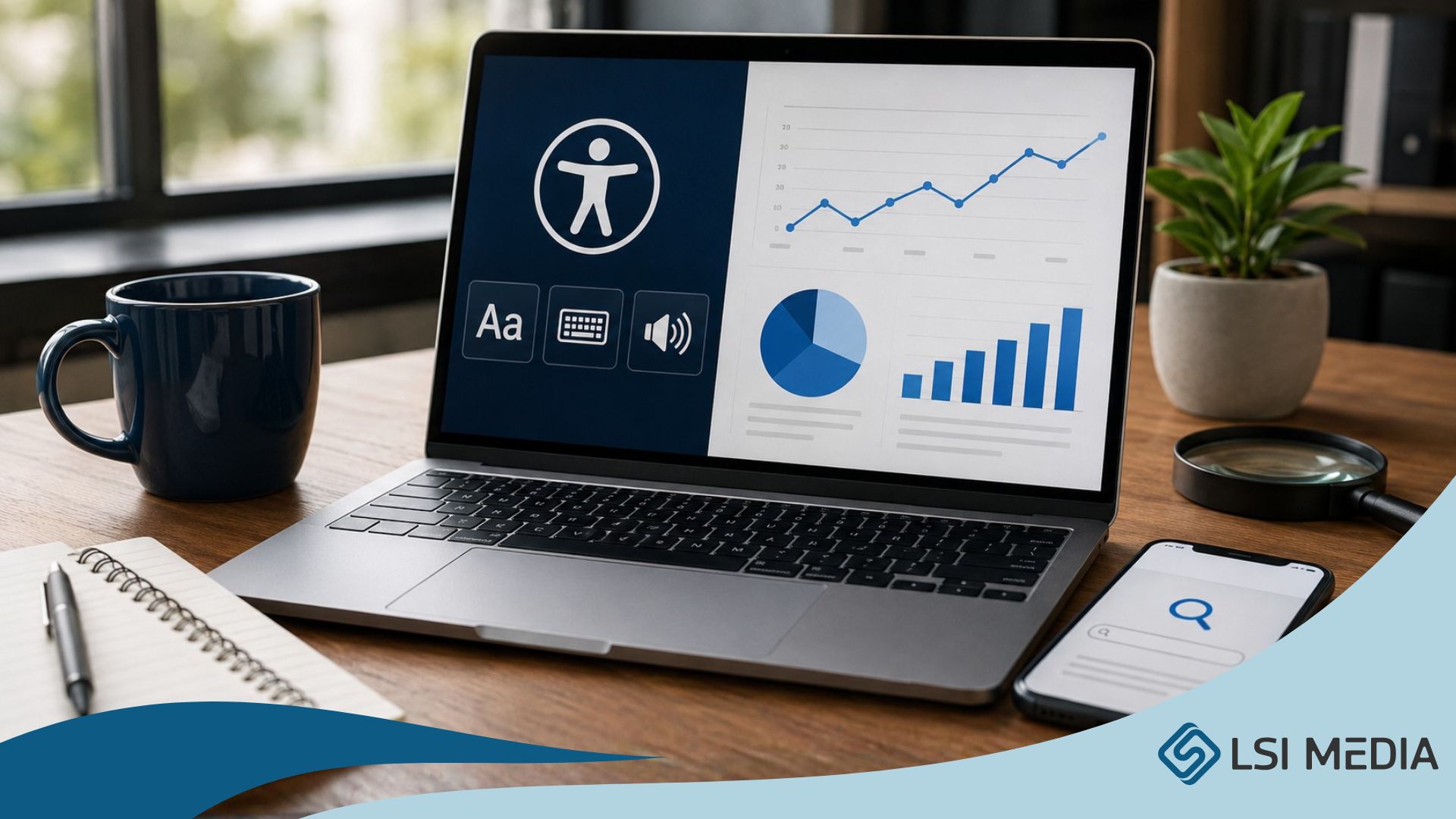
If a highly motivated donor with a visual impairment visits your site on a giving day and your donation form isn’t compatible with their screen reader, what do they do? They bounce. You didn’t just lose a donation; you failed to serve your community. Studies show that a significant percentage of users will abandon a website if it presents accessibility barriers (source).
At LSI Media, accessibility is not a plugin we activate at the end of a project. We build WCAG 2.1 AA conformance into the process from day one. Both of our founders, along with key team members, hold the rigorous DHS Trusted Tester certification. We handle Section 508 testing and remediation for websites, documents, and PDFs.
When your giving days website architecture is fundamentally accessible, you aren’t just checking a compliance box for government or commercial standards—you are maximizing your ROI by ensuring absolutely every willing donor can easily support your mission.
SEO: Capturing the Organic Giving Day Surge
Here is a massive mistake I see organizations make all the time: they drive 100% of their giving day traffic through paid ads and email blasts, completely ignoring organic search.
When people hear about your campaign on social media or from a friend, a huge portion of them will simply Google your organization’s name plus “Giving Tuesday” or “donate.” If your technical SEO is a mess, or your site is painfully slow, you won’t rank for your own branded terms when it matters most.
Because creative and technical work aren’t handled by separate teams at LSI Media, the people who design your website are simultaneously optimizing it for search visibility. We ensure your site speed, mobile responsiveness, and URL structures are dialed in. SEO is built into the foundation so that when the giving day surge happens, search engines know exactly where to send your potential donors.
The High-Traffic Action Plan
You need to move from reactive to proactive. If you have a giving day on the horizon, here is the playbook to fortify your architecture right now:
- Audit Your Plugins: WordPress is powerful, but bloated plugins are the enemy of speed. Audit your stack and remove anything that isn’t absolutely necessary for the campaign.
- Implement Server-Level Caching: Don’t rely solely on basic caching plugins. Ensure your hosting environment is configured to handle traffic spikes without querying your database for every single page load.
- Test the Donation Flow for Accessibility: Run your specific giving day landing pages and payment gateways through rigorous WCAG 2.1 AA testing. If a keyboard-only user can’t navigate it, fix it immediately.
- Leverage AI Automation for the Backend: We help organizations put AI to practical use. Look at integrating AI automations to instantly categorize donor data and trigger personalized thank-you workflows, taking the manual load off your team during peak hours.
- Run a Load Test: Simulate high traffic. Send thousands of virtual users to your donation page in a staging environment to see exactly where the architecture breaks down. Fix the bottleneck before it goes live.
Handling transaction volume efficiently means optimizing how your architecture interacts with payment gateways like Stripe or PayPal. A robust high-traffic plan must account for API rate limits and utilize webhooks to process payment confirmations asynchronously, preventing donor checkout queues from timing out. Furthermore, establishing this direct, secure communication ensures that the system maintains strict PCI DSS compliance, protecting sensitive donor data without routing credit card information directly through your own web servers.
Structuring for Gamification and Social Proof
Giving days thrive on momentum. Features like real-time leaderboards, countdown clocks, and live social media feeds build excitement and drive urgency. However, these dynamic elements demand frequent server requests that can drag down performance if not architected correctly. Properly structuring these features ensures they update smoothly without putting unnecessary strain on your database during traffic spikes.
Build the Machine
Stop letting preventable technical failures cap your growth. You are doing incredible, mission-driven work, and you deserve a digital infrastructure that works just as hard as you do.
At LSI Media, we bridge the gap between creative design and hardcore project management discipline. Whether you are a nonprofit gearing up for a massive campaign, an association scaling your member services, or a commercial enterprise looking for serious digital transformation, we have the 25-year track record to back it up.
Don’t wait until the server crashes to figure out your giving days website architecture. Build the machine the right way, scale your impact, and go change the world.
To ensure your infrastructure is truly ready, your development phase must incorporate rigorous load testing and active Application Performance Monitoring (APM). APM tools allow development teams to monitor database query times, track server health, and isolate memory leaks before they result in a critical failure on the big day. Alongside these monitoring protocols, implementing proactive DDoS protection is essential to differentiate between legitimate surges in donor traffic and malicious attempts to overwhelm your network infrastructure.
© LSI Media LLC